A “10 ton” label does not tell you what a crane can lift at every boom length, radius or reeving arrangement. By the end, you will know which measurements, hardware, interfaces, configuration records and acceptance tests belong in a purchase specification before you compare quotations.
Key takeaways
- Treat 10 tonnes as a configured range, not capacity across every lift.
- Match the LMI to the crane’s load chart and operating configuration.
- Specify sensors, alarms, cut-outs, data logging and fault responses together.
- Accept the system by testing readings, alarms and safety functions under controlled lifts.
What Does a 10 Ton Rating Mean on a Crane?
A 10-ton rating usually identifies the rated-load range configured into an LMI; it does not promise that the crane can lift 10 tonnes throughout its working envelope. The crane manufacturer’s load chart determines the allowable capacity at each operating condition.
Rated load is the suspended force at the hook. Load moment is approximately load multiplied by the horizontal radius: 10 tonnes at 5 metres produces about 50 tonne-metres, while 10 tonnes at 10 metres produces about 100 tonne-metres. The same load can therefore be acceptable near the crane and unsafe farther away.
At a specific operating condition, allowable capacity depends on:
- Horizontal radius from the rotation or support point
- Boom length and boom angle
- Trolley position on an overhead, bridge or gantry crane
- Hook attachment, spreader or lifting device
- Number of rope falls and the reeving arrangement
A 10-ton LMI must be configured around this load-moment envelope, not selected from maximum hook load alone. A buyer requesting a 10 ton load moment indicator for industrial automation in Pune should provide the crane manufacturer’s load chart and exact operating configuration.
Without those documents, the supplier cannot reliably set capacity limits, alarm thresholds or overload outputs for the crane’s actual geometry.
What Belongs in a Complete LMI Package?
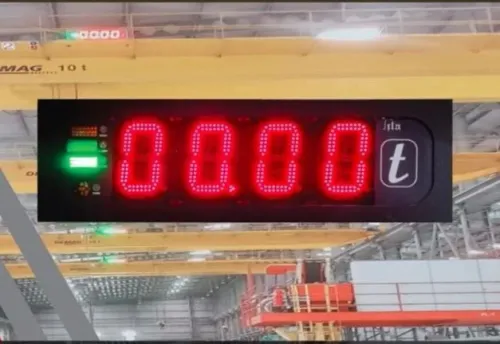
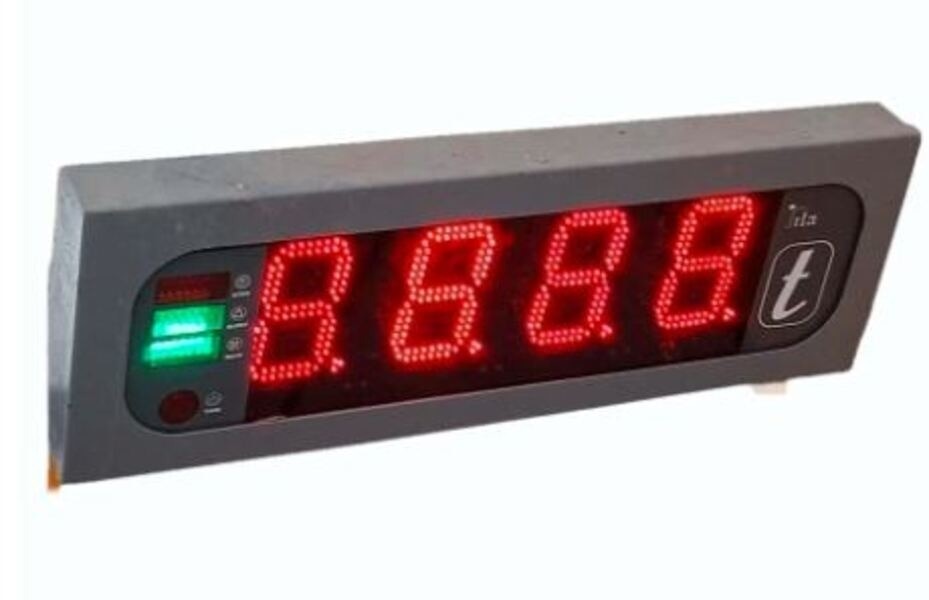
A complete load moment indicator package is more than an operator screen. A load moment indicator package normally includes:
- Load cell, load pin, rope-tension interface, or hydraulic-pressure interface
- Boom-angle and boom-length sensors where the crane requires them
- Trolley-position sensing for bridge, overhead or gantry cranes
- Controller, operator display, junction box, cable harnesses and sealed cable glands
- Audible and visual alarms, relay outputs, installation brackets and mounting hardware
- Configuration software or configuration records, data logging and a communications gateway
The controller combines measured load with radius, trolley position or equivalent geometry. It calculates load moment as load multiplied by radius, then compares that condition with the crane’s configured allowable-capacity envelope. The crane’s load chart, reeving and attachment data determine that envelope.
| Measurement | What it provides | What it cannot decide |
|---|---|---|
| Digital load cell | Force at one measurement point | Whether the crane is within capacity at a radius |
| Load moment indicator | Load plus geometry-based capacity comparison | A safe limit without correct crane configuration |
| Gross-load setup | Suspended load including hook, block, spreader, slings and lifting beam | Payload-only weight unless those items are tared |
Tare is the zeroing convention for the empty hook or specified below-hook equipment. Gross suspended load includes the hook, hook block, spreader, slings, lifting beam and other attached gear unless the approved configuration defines a net-load display. Require the measurement point and tare procedure in the configuration record for any industrial automation LMI.
Which Crane Configurations Can a 10 Ton LMI Fit?
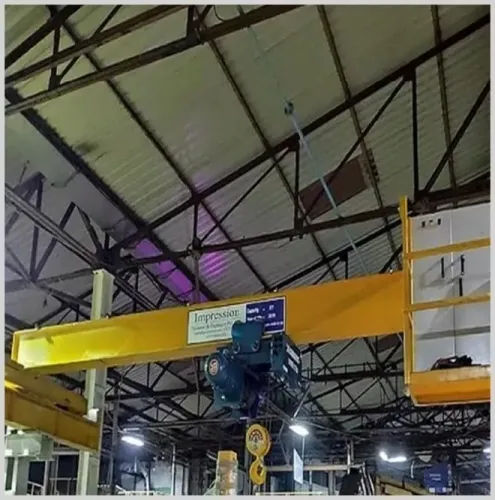
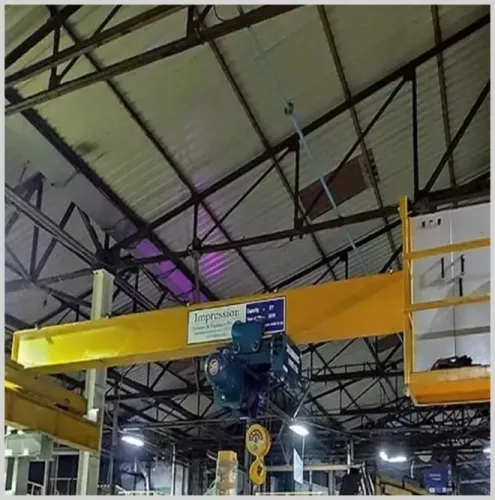
Fit depends on the crane’s operating geometry, not the “10 ton” label. An overhead or bridge crane may need hoist-load and trolley-position sensing; a mobile or telescopic crane may need load, boom angle, boom length and radius sensing.
A gantry or portal crane, jib crane, hoist or custom lifting machine needs its own measurement points confirmed.
| Crane configuration | Main variables to verify | Typical measurement need |
|---|---|---|
| Overhead or bridge crane | Hoist, trolley travel, falls and attachment | Suspended load plus trolley position |
| Gantry or portal crane | Trolley travel, span arrangement, falls and attachment | Suspended load plus position or radius |
| Jib crane or hoist | Jib geometry, hoist travel, falls and attachment | Suspended load; radius sensing where capacity changes |
| Mobile or telescopic crane | Boom angle, extension, radius and load chart | Load, angle, length and geometry |
| Other configuration | Manufacturer’s design and rated-capacity limits | A configuration-specific sensor package |
Give the supplier this ordering checklist:
- Crane make and model
- Maximum rated capacity and load chart
- Number of falls, rope diameter and reeving arrangement
- Boom geometry, angle range and extension range
- Trolley travel
- Hook block and lifting attachment
- Power supply and existing control-panel interface
- Installation location and environmental exposure
A 10 ton crane load indicator may display suspended force at one point. A safe load indicator or LMI also compares that reading with configured limits, using radius or equivalent geometry.
Therefore, a generic “10 ton LMI in Pune” quotation is incomplete unless it states which variables the package measures, where it measures them and which load chart governs the decision.
What Automation and Fault Responses Should You Specify?
A warning-only LMI shows load or overload status and alerts the operator. Crane LMI automation goes further by exchanging data with a control system or inhibiting motion, but only where the crane design permits that function.
| Option | Interface or response | Specify |
|---|---|---|
| Operator warning | Audible and visual alarm, acknowledgement and event logging | Alarm thresholds, reset authority and update rate |
| Control-system exchange | Isolated relay contacts, 4–20 mA, digital PLC inputs and outputs, CAN or serial communications | Signal meaning, PLC input/output ownership and reboot behavior |
| Plant integration | Modbus gateway, SCADA connection and remote monitoring | Protocol, data points, communication-loss response and recording interval |
| Motion protection | Hoist, trolley or travel cut-off | Confirm permission from the crane designer; define the de-energised safe state |
For an industrial automation LMI, require a defined response to sensor failure, broken wiring, power loss, invalid configuration, frozen readings and lost communications. The display must announce the fault and trigger the agreed safe response; silently holding the last valid load reading is not an acceptable default.
Specify these installation details before ordering:
- Supply voltage and tolerance, grounding, fuse or circuit-breaker size, and surge protection
- Cable separation from motor and variable-frequency-drive wiring
- Power-interruption recovery and restart rules
- Separate IP ratings for sensors, junction boxes, displays and control enclosures
Do not treat PLC compatibility as proof that the LMI safety function protects personnel. Define bypass control, alarm acknowledgement and every automatic action in the approved control design.
How Do You Compare, Install and Accept the System?
Do not compare quotations by the printed 10-ton label. A 10 ton LMI in Pune is comparable only when each supplier states the crane configuration, measured variables and tested performance.
| Item | Require in the quotation | Why it matters |
|---|---|---|
| Sensor and crane limits | Sensor capacity, configured crane capacity and moment envelope | Separates sensor range from the crane’s load-chart limits |
| Performance | Measurement uncertainty and tare convention | Defines accuracy and whether hooks, blocks and slings are included |
| Protection and control | Alarm thresholds, overload outputs and approved configuration | Shows what warns, inhibits motion or changes with the selected setup |
| Interfaces and enclosure | Every protocol, plus the IP rating for each sensor, junction box, display and control enclosure | Prevents an unplanned PLC or site-environment mismatch |
A sensor calibration certificate proves the sensor response at calibration; it does not prove correct installation, configuration or alarm operation. Ask a Pune supplier such as SMARTITA PRIVATE LIMITED for a configuration-specific bill of materials, wiring diagram, PLC interface schedule, installation materials, commissioning report and named service responsibility.
Make installation acceptance a controlled test against the crane’s load chart. Record the following:
- Verify load, radius, boom angle and boom length readings against known conditions.
- Test warning alarms, overload outputs and relay operation at the agreed thresholds.
- Remove and restore power to check recovery, then simulate sensor, wiring and communication faults.
- Sign the final configuration record, including tare, limits, protocols and software settings.
For a 10 ton load moment indicator for industrial automation in Pune, accept the installed system, not the box or certificate.
Related product
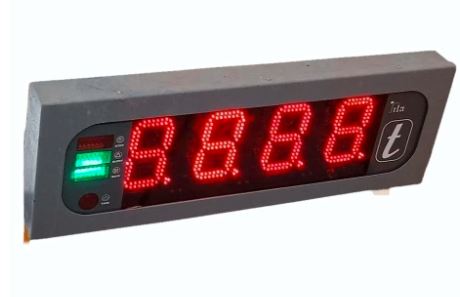 | Load Moment Indicators 10 Ton Load Moment Indicator (LMI) ₹48000 Load Moment Indicators of a wide range of products which include 10 ton load moment indicator, 50 ton load moment indicator, 20 ton load moment... View product → |
Frequently asked questions
What does a 10-ton rating mean on a crane LMI?
It identifies the LMI’s configured rated-load range. The crane’s load chart still determines allowable capacity at each radius, boom angle, height and configuration.
What belongs in a complete 10-ton LMI package?
Specify the display, load and position sensors, junctions and cabling, alarm outputs, overload or cut-out functions, calibration records and installation documentation.
Which crane configurations can a 10-ton LMI fit?
Fit depends on the crane type, load chart, boom or jib arrangement, hoist setup, reeving, mounting space and required sensor inputs. Confirm these before selecting the package.
What automation and fault responses should you specify?
Define warning and overload thresholds, audible and visual alarms, permitted cut-outs, sensor-failure behaviour, emergency handling, event logging and operator reset rules.
How do you compare, install and accept a 10-ton LMI?
Compare sensor range, accuracy, interfaces, environmental protection, documentation and service support. Then verify installation against the load chart and test readings, alarms and safety functions before acceptance.